In today’s rapidly evolving tech industry, the terms Software Engineer and Software Developer are often used as if they mean the same thing. While the two roles share similarities and frequently work side by side, they differ in mindset, responsibilities, and the level at which they interact with a system. Understanding these differences is essential not only for businesses building effective teams but also for individuals choosing the right career path in technology.
The Core Focus: Structure vs. Implementation
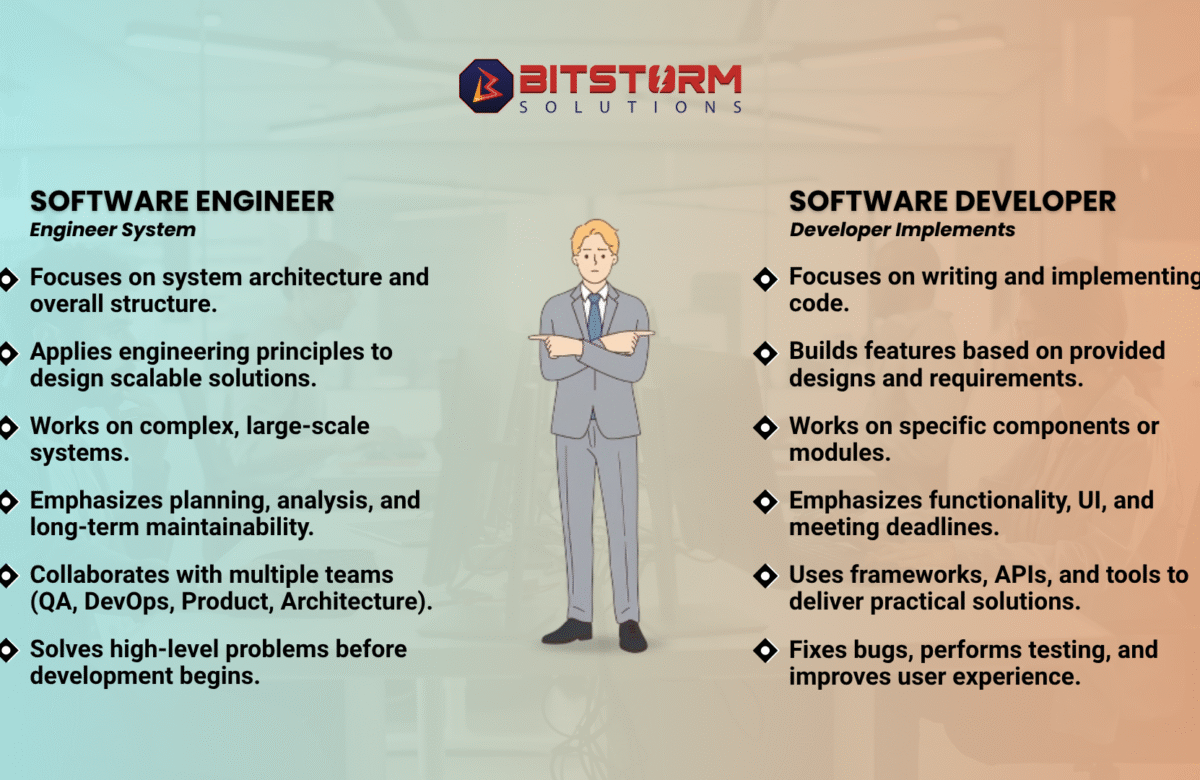
A Software Engineer is deeply involved in designing the overall structure of a system. Their work revolves around applying engineering principles to plan systems that are scalable, reliable, and capable of handling long-term growth. Engineers consider how different components interact, how data moves throughout the system, and how the application will behave under varying loads. Their approach is strategic and analytical, ensuring that the foundation of the system supports future updates and complexities.
On the other hand, a Software Developer concentrates on translating concepts and system designs into working applications. Developers write the actual code that brings features to life, ensuring that the product is functional, efficient, and user-friendly. Their focus is on practical execution—turning plans into reality through clean, maintainable code. Developers often spend most of their time implementing features, improving user experience, and ensuring the software performs correctly for end-users.
Scope of Work: Big Picture vs. Specific Components
For a Software Engineer, the scope of work extends across large, interconnected systems. They analyze project requirements at a high level, break down complex problems, and design solutions that integrate smoothly with the rest of the infrastructure. Their involvement often begins long before development starts, during the planning and architecture phases. Engineers collaborate closely with architects, DevOps specialists, and product managers to ensure the entire system functions cohesively.
A Software Developer operates more narrowly within the system’s defined boundaries. Their responsibilities revolve around building specific modules, enhancing existing features, resolving bugs, and optimizing performance. While their work is essential to the system’s functionality, it usually focuses on a defined portion of the application rather than the entire architecture. Developers rely on the structured plans created by engineers to guide their coding efforts.
Work Approach and Methodology: Engineering Principles vs. Hands-On Coding
Software Engineers take an engineering-driven approach. They focus on system analysis, scalability planning, performance optimization, and long-term maintainability. They evaluate risks, anticipate bottlenecks, and design solutions that prevent future issues. Their decisions often influence the entire lifecycle of a product, from inception to release and beyond.
Software Developers take a hands-on, execution-oriented approach. They build the features that users interact with daily and ensure that the application runs smoothly. Developers convert technical plans into code, conduct testing, refine functionality, and update software based on feedback or evolving requirements. Their work ensures the system is usable, stable, and engaging.
Collaboration Style: Cross-Functional vs. Development-Focused
The role of a Software Engineer requires extensive cross-functional collaboration. Engineers align technical strategies with business goals, communicate with various teams, and ensure that all components work together. Their collaboration ensures that the system is future-proof and adaptable.
Software Developers collaborate primarily within the development team, working closely with engineers and fellow developers. Their interactions focus on understanding requirements, implementing changes, and delivering efficient solutions that meet user and business needs.
Problem-Solving Mindset: Architectural vs. Practical
Software Engineers tackle high-level challenges such as system performance, data flow, architecture design, and scalability. They solve problems that affect the entire system and require a deep understanding of engineering concepts.
Software Developers solve practical, immediate problems like debugging, feature implementation, code optimization, and improving overall usability. Their problem-solving approach is hands-on and directly impacts the user experience.
Conclusion: Two Roles, One Goal
While both Software Engineers and Software Developers contribute to creating high-quality software, their roles differ in scope, focus, and methodology. Engineers act as system architects, designing and planning the technical landscape. Developers bring these plans to life by writing functional, user-ready code.
Both roles are essential in the modern tech ecosystem, and their collaboration ensures that systems are not only well-designed but also efficient and enjoyable for users. Understanding the differences between these roles helps organizations build stronger teams and helps professionals choose the path that aligns best with their strengths and aspirations.
The future of retail will belong to those who leverage intelligence, not assumptions.